If you’ve been following this series from the beginning, you’ll know I’ve been tracing the arc of how my relationship with the Bible has slowly changed: the framework I inherited, the assumptions I absorbed before I knew they were assumptions, the historical forces that gave them shape, the warnings I was given about straying beyond them, and the surprisingly rich world I found when I finally did. It’s been something of a flyover, with broad strokes and wide angles, the kind you make before coming in for a closer look. And whether you’ve been along for the whole ride or are just now jumping in, this feels like a good place to circle for a bit, because what I want to do here is less about where I’ve come from or where I’m going and more about where I am right now. In my last post, I noted that the deeper I went into that world, the less familiar the world I came from became. And, somewhere along the way, I found myself in the precarious position of living between the two, and it’s the tension between those that I want to sit with in this post.
To start, the world that formed me is one I still know by heart. It’s a world where God is personal, present, and active, where the Bible can be trusted without reservation, read with confidence, and applied directly to your life. Every sermon comes with a takeaway, every passage with a principle, every tension with a resolution that wraps things up. The language is always practical: what God is calling you to, what this means for your marriage, your finances, your kids, your career. There’s a study Bible with footnotes that smooth over contradictions before you notice them. There are workbooks designed to turn Scripture into action steps. Hard questions get real answers. Suffering has a purpose. Doubt has a resolution. Everything fits together with a coherence that isn’t incidental to its appeal – it is the appeal. The community that forms around all of this is warm, tightly knit, and deeply serious about loving people well, and I’ve seen it work. I’ve seen people changed inside that world, loved back to life by communities that meant it when they said they loved one another. Whatever else I’ve come to think, that doesn’t become less true. And the further I travel from that world the more I want to say it clearly, because it would be too easy and too dishonest not to.
Then there’s the world I’ve discovered since, one which couldn’t feel more different. Where the first world reads the Bible with confidence toward application, this one reads it with curiosity toward understanding. It cares more about what the text actually is than what any tradition needs it to be. A world shaped by scholars who have spent lifetimes sitting with the Bible’s complexity rather than resolving it prematurely. Its worship tends to be more contemplative and liturgical, less concerned with relevance and more concerned with reverence. It may not give you bulleted lists of practical takeaways, but it will likely give you a host of questions that you can’t let go of. A world where faith is open-handed enough to follow truth wherever it may be found, even when that means loosening its grip on what it came in hoping to keep. More than anything, what draws me to this world is its posture toward curiosity itself, not as a side trail to be managed or a threat to be neutralized, but as one of the most natural and central expressions of faith itself. Something to be celebrated and nurtured rather than simply tolerated or ignored so long as it stays in line. A faith that assumes God is not diminished by whatever the truth may hold, but is somehow more fully encountered through it.
I’m reminded of this contrast every time I glance over at my bookshelf. On one shelf sit devotional writers, practical pastors, and clear communicators who emphasize life change, discipleship, and spiritual practices. Beside them are scholars who read Scripture with meticulous historical attention, comparing manuscripts, diving into ancient cultures, analyzing genres, and acknowledging the messy humanity of the text. There are Catholic thinkers beside Protestant ones, Orthodox writers next to secular historians, conservative apologists next to liberal theologians, and some voices who don’t believe in God at all but understand the Bible historically better than almost anyone on the planet. These books come from seminaries, monasteries, megachurches, universities, and research institutions scattered across the spectrum. Some speak with spiritual warmth, others with academic rigor. Some defend doctrine, others critique it. Some inspire the heart, others challenge the mind. And somehow all of them speak to me. Each book feeds something different: some calm my soul, some stretch my mind, some irritate me but in ways that force me to grow. The shelf shouldn’t make sense, but it does, because I no longer live entirely in one world. My inner landscape has become a shared bookshelf where these worlds sit side by side, even though their underlying frameworks may clash.
And that brings me to the heart of the tension, one that stems from whenever the world I came from seems to lean more on confidence than curiosity. Where the framework has already decided what the Bible is, what it says, and what it means before the conversation even begins. Where all of the most important questions have already been settled and all that remains is simply to learn and apply. And I constantly find myself wanting to back up for a minute. To ask the questions that have already been closed. To sit with things like whether a particular doctrine is really true or whether a particular event really happened the way the Bible says it did, what difference (if any) it would make if not, and what honest inquiry might actually find if it were given the room. Not out of suspicion or cynicism, but out of a genuine desire to know. Sometimes that means wanting to push back on claims that careful scholarship simply doesn’t support. Other times it just means wanting to examine what everyone else seems content to assume. Because what I’ve come to value is an inquisitive faith that is open to exploration, one that welcomes honest questions rather than deciding in advance which ones are allowed. And yet, when I first started exploring on my own, it wasn’t what I found that disturbed me. It was that the world I came from had no home for it. No language, no path, nothing to help me figure out how to incorporate it into the faith I’d inherited. If anything, it actively resisted the attempt. And that, more than anything, is what makes the world I came from feel like a place I still love but can no longer quite call home.
What makes it even more peculiar is that it didn’t start with disillusionment. It started with excitement. The feeling of reading a serious scholar, time after time, and arriving at the same sense of amazement: why had nobody told me this? Things were finally starting to make sense. The thrill of it was real, and I couldn’t wait to bring it home. After all, it’s not like I was out there chasing ancient aliens or cracking secret codes. I was simply reading the standard findings of mainstream scholarship. The kind of scholarship that’s been around for more than a hundred years, and which pretty much represents the standard curriculum of study in most universities and seminaries around the world. I genuinely believed that if people could just see what I was seeing, they would experience it the way I experienced it. Spoiler: they didn’t. And not because anyone thought I was being reckless or trying to cause trouble. It was simply that what I kept finding didn’t fit inside the traditional frameworks that were already in place. And the longer I carried it, the clearer it became that I was going to have to carry it alone. That’s when the exhilaration eventually gave way to grief, realizing that what made so much sense to me didn’t quite translate, and the accompanying loneliness of bringing something home only to find that home had no place for it. Part of that grief, if I’m honest, is that I still miss what I once had in that world. Not because I doubt what I’ve come to learn, but because I miss the warmth and solidarity of a world where what moves you moves the people around you in the same way. Where everyone is singing from the same page.
Sitting with all this long enough, though, I’ve come to see that the deepest part of the tension isn’t really theological at all. It’s something far more personal than that. Something that has to do not just with how I read the Bible but with who I am. Which world forms me? Where do I actually belong? Some days I feel like a dual citizen, welcomed in both places but fully at home in neither. Other days it’s more like being a tourist everywhere, which sounds exciting until you realize you’re also the one carrying all the luggage. The truth is that each world gives me something the other can’t. The first gives me warmth, expectation, the sense that God is near and that faith is something lived in community rather than thought through in isolation. The second gives me honesty, depth, the freedom to ask questions without having to already know where they’ll land. And I’ve slowly had to make peace with the fact that I don’t seem to be able to choose between them, not because I lack the courage to commit, but because the commitment I feel runs in both directions at once. My personality has always gravitated toward order and clarity, toward having things settled and in their proper place. Yet my inner life, at this particular point in the journey at least, is neither of those things. And I’m not sure it should be. I’m learning, slowly and not always gracefully, to make peace with that.
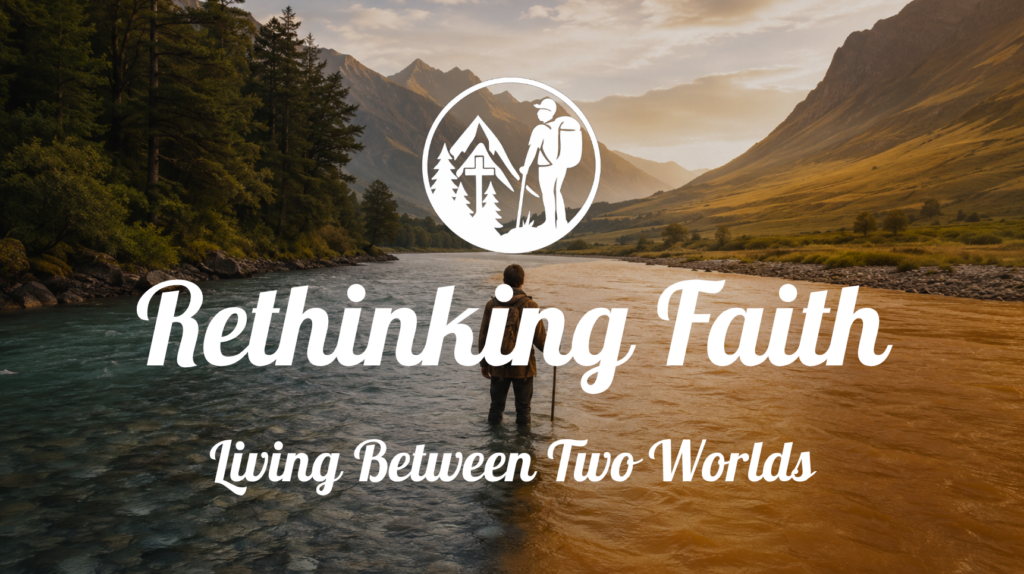
Which brings me to an image that keeps coming back to me. It’s an image of two rivers meeting: one warm and familiar, carrying the belonging and the simple certainties that first shaped me, the memories and the community and the sense that faith is something you feel more than you think; the other clearer and colder, carrying the honesty my mind now seeks, and the freedom to ask hard questions and follow them wherever they lead, even when the answers are uncomfortable. For a long time I wished I could simply choose one and move on. But I’m beginning to wonder whether the point was never to choose, and whether learning to stand at the place where they meet might actually be its own kind of faithfulness. To live with an open heart, a curious mind, and enough courage to trust that God is just as present here as anywhere else. And who knows, my mind may someday find its way back to the world I came from. Or my heart may find the warmth it seeks in the other. Or maybe I’ll simply learn to make a life right here in the middle. Either way, I want to stay open to wherever God leads me, even if the rivers bend in ways I can’t yet see.
All that said, standing in the middle doesn’t mean standing still. And so next time, with this tension now in view, I want to bring the flyover to an end. To trade the wide angles for a closer look, moving beyond the broad landscape of my shifting views on the Bible to some of the specific ideas that have been reshaped along the way. After all, if my understanding of Scripture has changed, what does that mean for the questions I once treated as settled? Isn’t the Bible inspired? If so, in what sense? What does its authority look like if the text is ancient, human, and diverse? More practically, how should I interpret it and apply it to my life? These are the waters I want to wade into next, beginning with inspiration, a word that once felt like bedrock but now flickers like a flame I can’t quite hold steady in my hands.
Until then, thanks again for reading and – as always – stay curious, seek truth, and love well.